How Does an Aerial Work Vehicle Steering Cylinder Work? A Technical Overview for Equipment Buyers
When a scissor lift glides smoothly across a warehouse floor, or a boom lift pivots with precision on a construction site, few operators think about the hydraulic component quietly making that directional control possible. The hava iş aracı direksiyon silindiri is one of the most mechanically critical — yet most overlooked — components in elevated work platform systems. For procurement managers, fleet operators, and OEM engineers sourcing hydraulic parts for aerial equipment, understanding how this cylinder works is the foundation of making sound purchasing and maintenance decisions.
This article walks you through the working principle, structural components, key performance parameters, and common configurations of aerial work vehicle steering cylinders, giving you a reliable technical baseline before you request a quote or inspect a shipment.
The Role of the Steering Cylinder in Aerial Work Vehicles
Aerial work vehicles (AWVs) — including scissor lifts, articulating boom lifts, telescopic boom lifts, and spider lifts — rely on hydraulic systems to perform virtually every primary function: lifting, extending, leveling, and steering. The steering cylinder is the actuator responsible for converting hydraulic pressure into the linear motion that moves the steering linkage, which in turn changes the direction of the drive wheels.
Unlike automotive rack-and-pinion steering, AWV steering systems are typically pure hydraulic, meaning there is no mechanical steering column connecting the operator’s controls to the wheels. Instead, a proportional control valve regulates fluid flow into the steering cylinder, and the cylinder’s piston rod physically pushes or pulls the tie rods that pivot the wheel assemblies. This architecture gives aerial platforms the tight turning radii and low-speed precision maneuverability they need in confined job sites.
On most scissor-type AWVs, front and rear steering cylinders operate together — sometimes in the same direction for conventional steering, sometimes in opposite directions for crab steering — dramatically reducing the vehicle’s turning radius on restricted indoor floors.
Core Structure: What’s Inside a Steering Cylinder
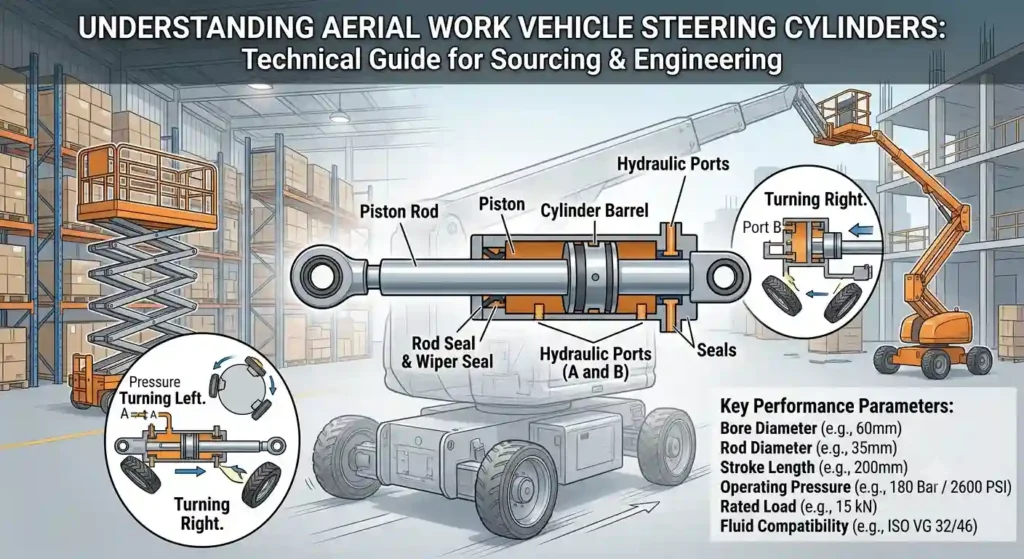
A standard aerial work vehicle steering cylinder is a double-acting hydraulic actuator. “Double-acting” means hydraulic pressure can be applied to both sides of the piston, enabling controlled extension and retraction in both directions — essential for two-way steering. The main structural elements include:
- Cylinder barrel: Typically precision-honed seamless steel tube, with an internal bore surface hardness and finish that determines seal life and leak resistance. Common bore diameters for AWV steering range from 40 mm to 80 mm depending on vehicle class.
- Piston and piston rod: The piston divides the barrel into two hydraulic chambers. The rod, usually chrome-plated hardened steel, exits through the front gland and connects to the steering linkage. Chrome plating thickness and hardness directly affect corrosion and wear resistance — a key quality differentiator between suppliers.
- End caps and gland: The rear end cap closes the cylinder and provides a port for hydraulic fluid entry. The front gland (also called the rod seal housing) supports the rod and contains the primary wiper and lip seals that prevent fluid leakage and contamination ingress.
- Seal package: Consists of piston seals (to prevent fluid bypass between chambers), rod seals (to prevent external leakage), and wiper seals (to scrape contaminants off the rod before it re-enters the cylinder). Seal material selection — Nitrile, Polyurethane, or PTFE-based — affects performance across temperature ranges and chemical environments.
- Mounting hardware: Clevis ends, cross-tube mounts, or threaded boss mounts are machined or welded to both ends of the cylinder to interface with the vehicle’s frame and linkage.
Step-by-Step: How the Steering Cylinder Generates Motion
The steering sequence begins when the operator moves the drive joystick or steering control on the platform console. This sends an electrical signal to a solenoid-operated directional control valve in the hydraulic manifold. The valve shifts, directing pressurized fluid from the hydraulic pump into one of the two ports on the steering cylinder.
If the vehicle is turning right, pressurized fluid enters the rod-side port of the cylinder. This pushes the piston toward the cap end, retracting the piston rod. The retracting rod pulls the left steering knuckle inward through the tie rod, causing the left wheel to pivot right. Simultaneously, return fluid from the cap-side chamber flows back to the hydraulic reservoir through the opposite port.
For a left turn, the valve reverses flow: fluid enters the cap-side port, extending the piston rod, which pushes the right side of the steering linkage and pivots the wheels left. The speed of extension or retraction is proportional to the volume flow rate from the pump — giving operators variable-speed steering response.
On machines with four-wheel steering (common in larger rough-terrain scissor lifts), two steering cylinders operate simultaneously under coordinated valve control, enabling both conventional and crab-steer modes.
Key Performance Parameters Buyers Should Evaluate
When sourcing aerial work vehicle steering cylinders, the following specifications should be confirmed with the supplier before placing an order:
- Working pressure: Most AWV steering cylinders are rated for 16–20 MPa (2,300–2,900 PSI). Ensure the rated pressure matches or exceeds the hydraulic system pressure of the target machine.
- Bore diameter and stroke length: These determine the force output and range of motion. Mismatched dimensions will prevent proper fit or insufficient steering angle.
- Rod diameter and chrome plating spec: A thicker chrome layer (minimum 15–25 µm hard chrome) improves corrosion resistance in outdoor environments.
- Seal material compatibility: Confirm seal compounds are compatible with the hydraulic fluid type used in the AWV (mineral oil, synthetic, or fire-resistant fluids).
- Mounting style and interface dimensions: Clevis pin diameter, eye bore diameter, and overall closed length (OCL) must match OEM specs or the cylinder will not install correctly.
- Certification: For equipment destined for North American or European markets, look for ISO 9001-certified manufacturing and cylinders tested to CE or ANSI/ASME standards.
Double-Acting vs. Single-Acting: Why AWVs Always Use Double-Acting Cylinders
A single-acting cylinder uses hydraulic pressure in one direction only, relying on a spring or gravity to return the piston. These are suitable for vertical lift functions where gravity provides the return force. For steering, however, single-acting cylinders are mechanically inadequate: the vehicle must be capable of turning with equal force and speed in both left and right directions, regardless of terrain slope or load shift.
Double-acting steering cylinders provide symmetrical hydraulic force in both directions, giving operators consistent steering response whether turning into or away from a loaded condition. This symmetry is non-negotiable for safe operation of aerial platforms at height, where a sudden lurch during a direction change could destabilize the elevated platform.
Material and Manufacturing Quality Indicators
The working environment for AWV steering cylinders varies widely — from clean indoor warehouse floors to muddy outdoor construction sites. Quality manufacturing starts with the barrel: it should be cold-drawn or hot-rolled seamless steel tube, finish-honed to Ra 0.4 µm or finer for optimal seal contact. The piston rod should be drawn from C45 or 40Cr alloy steel, induction-hardened, and hard-chrome plated.
Welded joints (if present, on the end caps) should be full-penetration welds, with post-weld heat treatment to relieve residual stress. Cylinders destined for outdoor use should have additional external corrosion protection — zinc phosphate primer plus polyurethane topcoat is a common standard.
For buyers pairing AWV equipment with agricultural attachments — for example, operators who also manage tractor-based equipment like hay balers on mixed-use farms or facilities — you may find it useful to review compatible hay baler equipment resources here, as PTO and hydraulic compatibility is a common cross-equipment concern.
Common Failure Modes and What They Tell You About Quality
Understanding failure patterns is one of the most effective ways to evaluate a steering cylinder’s design quality before purchase:
- External rod seal leakage: Usually caused by hardened or cracked rod seals due to thermal cycling, contaminated fluid, or an overly rough rod surface finish. High-quality cylinders use polyurethane or PTFE lip seals rated for wide temperature ranges.
- Internal bypass (slow steering response): Worn or damaged piston seals allow fluid to cross between chambers without generating force. This appears as slow, sluggish, or asymmetric steering. Replacing piston seals restores function, but premium cylinders use PTFE-backed slipper seals to minimize this failure mode.
- Rod scoring: Contaminants entering past a worn wiper seal can score the chrome surface, creating grooves that accelerate subsequent seal wear. The wiper seal (dust seal) quality is a first line of defense and is often the first seal to degrade on poorly maintained machines.
- Barrel end cap thread failure: In cylinders with threaded end caps (vs. welded), under-torqued or corroded threads can allow the cap to loosen under cyclic hydraulic loads. Quality cylinders should specify thread class and torque values in their documentation.
Sourcing Considerations for B2B Buyers
For OEM manufacturers integrating steering cylinders into new AWV designs, working with a supplier who offers custom bore/stroke configurations, prototype support, and batch consistency documentation is essential. For aftermarket distributors, the priority shifts to dimensional interchangeability with major AWV brands (JLG, Genie, Skyjack, Haulotte) and competitive lead times.
In either case, request material certifications (mill certs for steel), seal supplier disclosures, pressure test records, and dimensional inspection reports with each production batch. These documents protect you in warranty claims and customer disputes.
Ready to Source Aerial Work Vehicle Steering Cylinders?
Canada oxygen-compressor-cylinder-filling Co., Ltd supplies precision-engineered double-acting steering cylinders for scissor lifts, boom lifts, and aerial platforms. We support custom bore/stroke specifications, OEM replacement fitment, and volume B2B orders with full material documentation.
📧 Contact us at satış@oksijen-kompresör-silindir-doldurma.com to request a quote, technical datasheet, or sample arrangement today.