Beyond the Field: 7 Unexpected Applications of Fertilizer Spreader Gearboxes in Modern Agriculture
Ask most people what a fertilizer spreader gearbox is used for, and the answer will be predictable: spreading granular fertilizer across crop fields. That answer is not wrong — but it captures only a fraction of the mechanical reality. The PTO-driven spreader gearbox is one of the most versatile power transmission components in the agricultural and municipal equipment world, and its application range has expanded dramatically as equipment manufacturers have recognised the gearbox’s ability to handle a wide variety of rotary spreading and distribution tasks with minimal modification.
For agricultural equipment dealers, OEM integrators, and procurement specialists, understanding these broader applications opens up new market opportunities and helps justify stocking a wider range of gearbox configurations. This article outlines seven significant applications of fertilizer spreader gearboxes that go well beyond conventional field cropping — each with distinct performance requirements and sourcing considerations.
Application 1 — Winter Road De-Icing and Salt Spreading
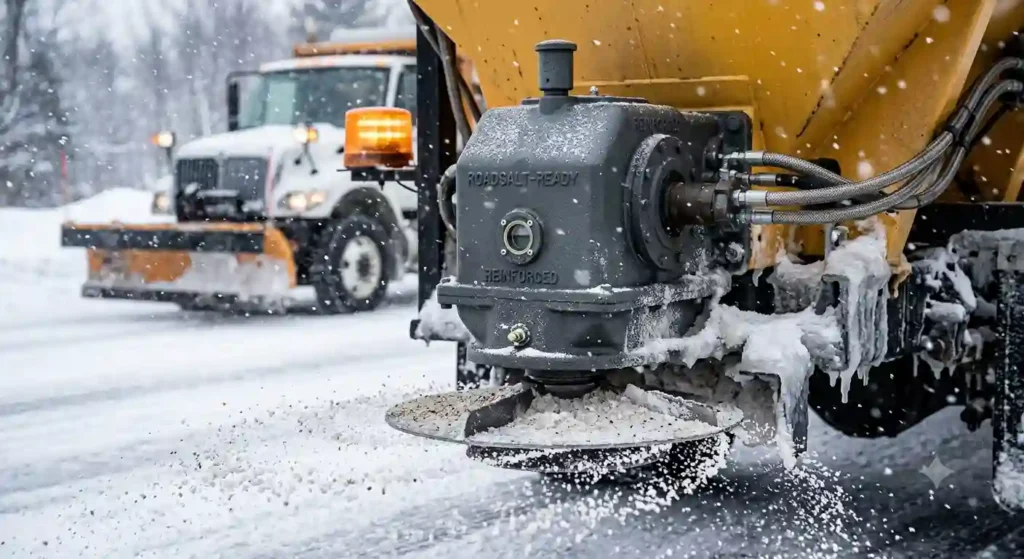
Municipal road maintenance departments, highway authorities, airport runways, and private estate managers rely heavily on salt and sand spreaders for winter traction management. The mechanical architecture of a road salt spreader is nearly identical to an agricultural fertilizer spreader — a hopper, a spinning disc or auger, and a PTO or hydraulic-driven gearbox to power the spreading mechanism.
The key difference is the operating environment: road salt (sodium chloride or calcium chloride) is even more aggressively corrosive than agricultural fertilizers, and spreaders in this application operate in wet, cold, and chemically hostile conditions throughout the winter season. Fertilizer spreader gearboxes specified for salt spreading applications should have sealed housing designs with corrosion-resistant coatings, stainless steel or zinc-plated fasteners, and high-quality lip seals rated for operation at temperatures as low as -20°C. The demand for replacement gearboxes in municipal fleets is substantial — making this a valuable aftermarket channel for dealers who stock winter-service-grade units.
Application 2 — Grass Seed and Overseeding Operations
Golf course groundskeepers, sports field managers, landscape contractors, and large-estate turf managers routinely use disc spreaders with gearbox drives for grass seed broadcasting — overseeding worn turf areas, establishing new fairways, repairing sports pitch surfaces, and seeding roadside verges and amenity areas.
Grass seed is significantly lighter and more variable in particle size than granular fertilizer, requiring precise disc speed control to achieve even distribution without throwing seed too far or too unevenly. Gearboxes for this application benefit from multi-ratio or adjustable-speed capability — the ability to run the disc at a lower output RPM than standard fertilizer spreading speeds. Some spreader designs achieve this through a secondary belt-and-pulley reduction stage driven off the gearbox output; others use a two-speed gearbox input to offer 540 or 1,000 RPM input options for speed selection.
The combination of fertilizer and seed spreading in a single tractor pass — using the same spreader and gearbox — is a common practice in arable overseeding systems, and gearboxes with robust sealing to handle the switch between material types without cross-contamination are particularly valued in professional turf management.
Application 3 — Lime and Soil Amendment Spreading
Agricultural lime (calcium carbonate), dolomitic lime, gypsum, and other soil amendment materials are applied across crop fields to correct soil pH, improve structure, and supply calcium and magnesium. These materials are typically fine-ground powders or granulated particles with very different flow and density characteristics compared to nitrogen or phosphate fertilizers.
Lime spreading places distinctive demands on the gearbox: lime is abrasive when dry and forms a corrosive paste when wet, and spreading rates are typically much higher than fertilizer (often 2–5 tonnes per hectare versus 200–400 kg/ha for fertilizer). This means the gearbox must handle sustained higher-load conditions over longer spreading runs. Torque capacity and bearing size are the primary gearbox specifications to verify for lime spreading compatibility.
Farms that use the same spreader and gearbox for both lime and fertilizer applications — common on mixed arable operations where liming is a once-every-three-year event interspersed with annual fertilizer runs — should confirm that the gearbox’s continuous torque rating comfortably covers the higher demands of lime spreading, not just the lighter fertilizer work it performs most frequently.
Application 4 — Vineyard and Orchard Fertilization
Viticulture and arboriculture operations present a specific set of spreader gearbox requirements driven by the confined row spacing of vineyards and orchards, the precision nutrient management demanded by high-value crops, and the often sloped terrain of wine-growing regions.
Vineyard spreader gearboxes are typically integrated into compact, narrow-track spreader units designed to pass between vine rows — sometimes as narrow as 1.4–1.8 metres. The gearbox must be compact in its external dimensions while delivering adequate disc drive torque. Under-vine spreading attachments — which extend the spreading mechanism laterally beneath the vine canopy — sometimes add a secondary bevel gear stage to drive side-extending augers or disc assemblies, adding complexity to the gearbox specification.
For orchards, where trees may be spaced on wider centres allowing standard spreader widths, the gearbox demands are closer to conventional field spreading — but the variable terrain common in fruit-growing regions (hillside orchards, contoured land) means the gearbox should be specified with a robust housing mounting that can handle operation at angles up to 15 degrees from horizontal without compromising oil retention or lubrication adequacy.
Application 5 — Compost and Organic Material Distribution

The growth of certified organic farming and the increasing use of on-farm composting in conventional arable systems has created significant demand for spreader gearboxes capable of handling semi-composted organic materials, poultry litter pellets, blood and bone meal, and granulated seaweed products. These materials span a wide range of particle sizes, moisture contents, and densities — all of which affect the spreading dynamics and load on the disc drive gearbox.
Granulated organic fertilizers (pelleted chicken manure, for example) tend to be softer and more irregular in shape than mineral fertilizer granules, leading to more variable disc loading and a higher risk of material bridging in the hopper. Bridging creates sudden surge events when the blockage clears — sharp torque spikes that can damage an under-rated gearbox. Specifying a gearbox with a service factor of at least 1.75 above the normal operating torque requirement is advisable for organic material spreading applications.
Farms transitioning to organic production or running mixed conventional/organic rotation systems should ensure their spreader gearbox is rated for the full range of materials they will spread during the transition period, rather than sizing for the organic material alone — which is typically less demanding than peak mineral fertilizer load conditions.
Application 6 — Pelleted Herbicide and Pesticide Application
Granular herbicides, pesticide pellets, molluscicides (slug pellets), and other solid agrochemical formulations are increasingly applied via disc spreaders rather than conventional knapsack or boom sprayer systems. Spreading granular pesticide formulations allows for precise application rate control, eliminates the drift risk associated with liquid spraying, and permits treatment in weather conditions (light wind, ambient humidity) that would prevent safe liquid spray application.
The gearbox demands for granular pesticide spreading are relatively modest from a torque perspective — application rates are low (typically 2–20 kg/ha for granular molluscicide, for example) and material density is similar to fine fertilizer granules. The primary concern is cross-contamination: a gearbox used interchangeably for fertilizer and pesticide spreading must be thoroughly cleaned between applications to prevent fertilizer residue from contaminating pesticide calibration and vice versa.
Some precision agricultural operations maintain dedicated spreader units with specific gearboxes for pesticide applications — ensuring no cross-contamination risk and allowing gearbox calibration to be locked to a single material density and spreading rate. For dealers, this practice creates demand for additional gearbox units as complementary parts of a complete farm spreading system.
Application 7 — Sports Field and Amenity Turf Management
Professional and semi-professional sports clubs, local authority parks departments, golf course management companies, and racecourse turf teams use disc spreaders with gearbox drives for a wide range of amenity turf treatments: fertilizer application, top-dressing sand spreading, herbicide granule application, fungicide pellet spreading, and autumn overseeding. The spreader gearbox in this context is often attached to a compact tractor or ride-on utility vehicle rather than a full agricultural tractor, requiring gearbox designs compatible with lower PTO power outputs (20–40 HP range rather than 80–150 HP agricultural spec).
Gearbox weight is a more significant factor in amenity turf applications than in field agriculture: a lighter gearbox reduces the risk of ground pressure damage to fine sports turf surfaces, and compact external dimensions are important for working on pitches with perimeter fencing or in tight maintenance compound areas.
For procurement teams managing amenity groundskeeping equipment alongside broader farm machinery fleets — including hay cutting equipment for sports ground perimeters or racecourse grass management — it is worth knowing that spreader gearbox compatibility with your tractor’s PTO should be confirmed across your entire equipment range. Commercial mowing and hay operations serving these environments can reference equipment options at hay-balers.com’s commercial tractor mowers section for compatible tractor-mounted implement specifications.
Itu EP-A15T Fertilizer Spreader Gearbox is well-suited to amenity applications, offering a compact form factor, low-noise helical gear design, and compatibility with a wide PTO input speed range — making it a versatile replacement unit for dealers supplying both agricultural and groundskeeping markets.
Summary: Matching Gearbox Specification to Application
| Aplikasi | Key Gearbox Requirement | Priority Spec |
|---|---|---|
| Road salt spreading | Corrosion resistance, low-temp seals | Sealed housing, -20°C rated seals |
| Grass seeding | Adjustable output speed | Multi-ratio or low-speed input option |
| Lime spreading | High continuous torque capacity | Oversized bearings, high service factor |
| Vineyard/orchard | Compact dimensions, angled operation | Small housing, oil-retentive at slope |
| Organic material | Shock load tolerance | High service factor, slip clutch pairing |
| Granular pesticide | Easy cleaning, material separation | Cleanable seal areas, no dead zones |
| Amenity turf | Low weight, compact form, low noise | Helical gears, lightweight housing |
Supplying Multiple Markets? We Can Help.
Canada oxygen-compressor-cylinder-filling Co., Ltd supplies fertilizer spreader gearboxes for agricultural, municipal, turf, and amenity applications. Our EP-A15T model suits a wide range of spreading tasks, and we can advise on specification selection for specific application requirements.
📧 Contact our sales team at [email protected] to discuss your application and request a product datasheet or volume pricing.