Forklift Steering Cylinders in Warehousing, Cold Storage, and Port Logistics: What Buyers Need to Know
Global supply chains have never been more complex, and the material handling equipment that keeps goods moving through distribution centres, cold chain facilities, and port terminals has never been under more operational pressure. At the centre of this equipment ecosystem sits the forklift — and at the centre of the forklift’s manoeuvrability sits the steering cylinder. Understanding how different operational environments affect steering cylinder performance, specification requirements, and maintenance intervals is essential knowledge for procurement teams and fleet engineers managing forklifts across diverse logistics settings.
This article examines three of the most demanding forklift operating environments — general warehousing and distribution, cold storage and refrigerated logistics, and port and intermodal container handling — and outlines how the steering cylinder requirements, failure patterns, and sourcing considerations differ meaningfully across these settings.
Environment 1 — General Warehousing and Distribution Centres
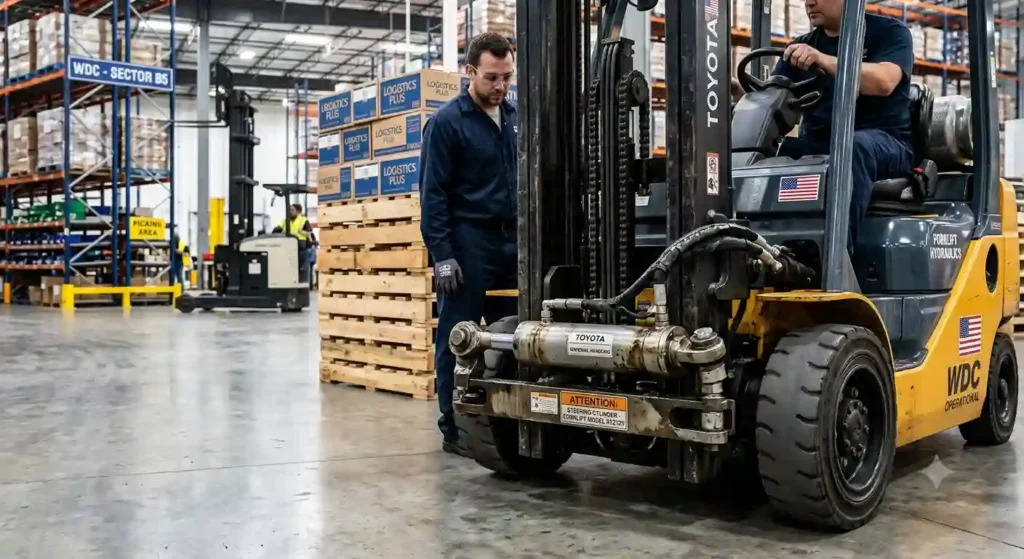
A typical large-scale distribution centre — handling FMCG products, retail supply, or e-commerce fulfilment — operates forklifts across multiple shifts, often 20 or more hours per day. The steering cycle count in this environment is enormous: a busy reach truck or counterbalance forklift operating in a 30-metre-wide racking bay may complete 60–80 full steering cycles per hour as it picks and deposits loads across narrow aisle widths.
The primary steering cylinder stressor in this setting is cumulative fatigue from high cycle frequency, rather than environmental harshness. Seal wear, wiper seal degradation, and eventual bearing wear in the mounting clevis pins are the dominant failure modes. Fleet engineers in distribution centres typically plan forklift hydraulic seal replacement as a preventive maintenance item at defined hour intervals — rather than waiting for visible leakage — to avoid unplanned downtime during peak operational periods.
Floor cleanliness is generally good in modern distribution centres, reducing the contamination burden on wiper seals compared to outdoor environments. However, pallet debris — broken pallet wood, plastic strapping fragments, and shrink wrap remnants — is a persistent hazard that can score rod surfaces if not removed regularly from the steering cylinder area during routine inspections.
Procurement strategy for distribution centre forklift steering cylinders should emphasise: seal durability (polyurethane or PTFE-backed seals over standard NBR for extended service life), availability of seal kits as a separate service part from the complete cylinder (to support in-house rebuild programmes), and supplier consistency across multiple orders to maintain the same seal specification throughout a fleet of identical machines.
Environment 2 — Cold Storage and Refrigerated Logistics
Cold store forklift operations represent one of the most demanding environments for hydraulic steering cylinder seals. Temperatures inside blast-freeze zones can reach -30°C or lower; conventional fresh-produce cold stores operate at 0°C to +5°C; and many cold chain operations involve forklifts cycling repeatedly between ambient dock areas and refrigerated storage zones, exposing the hydraulic system to extreme and rapid temperature fluctuations.
Standard NBR (Nitrile Butadiene Rubber) seal compounds, which perform adequately at ambient temperatures, become stiff and brittle below -10°C. A steering cylinder fitted with standard NBR seals and moved from an ambient loading dock into a -20°C blast freeze area will show dramatically increased steering resistance on the first steering inputs as the seals are too stiff to conform to the rod and bore surfaces. Over time, this cold-stiffening cycle causes seal cracking and premature failure — often within a fraction of the normal seal service life.
Cold storage forklift steering cylinders must be specified with low-temperature seal compounds — HNBR (Hydrogenated Nitrile), FKM (Viton) for the widest temperature range, or purpose-formulated cold-store polyurethane seals. These materials maintain adequate flexibility and sealing contact force across the full temperature range from -30°C to +80°C, dramatically extending seal life in cold chain environments.
Hydraulic fluid grade is equally important: standard ISO VG 46 or VG 68 hydraulic oil becomes viscous below -15°C, significantly increasing the pressure required to move the steering cylinder at low temperatures. Cold store forklifts should use low-viscosity, wide-temperature-range hydraulic oils (ISO VG 32 or VG 46 with low pour point additives) to maintain responsive steering at operating temperatures.
Condensation is a further hazard: when a cold forklift moves into a warm loading dock area, moisture condenses on all cold metal surfaces — including exposed piston rod sections. Repeated condensation events accelerate rod corrosion in cylinders with worn wiper seals, introducing water into the hydraulic fluid and creating the conditions for internal corrosion of the cylinder bore and piston. High-quality wiper seals with positive scraping action are the first line of defence against condensation-induced rod corrosion in cold chain operations.
Environment 3 — Port Terminals and Intermodal Container Handling
Container handling at port terminals — whether reach stackers, empty container handlers, or loaded container forklifts — represents the most mechanically demanding forklift application for steering cylinders. The machines are large (sometimes capable of lifting 45-tonne container loads), operate on unprepared or partially paved surfaces, work in salt-air coastal environments, and cycle continuously across long working shifts with minimal downtime.
Salt air corrosion is the dominant environmental challenge for steering cylinders in port settings. The combination of chloride-laden sea air, periodic rain wetting, and the inability to regularly wash and dry equipment in a busy terminal environment creates aggressive external corrosion conditions. Chrome plating quality on the piston rod becomes the critical quality differentiator: a 30–40 µm hard chrome layer with micro-crack-sealed surface treatment significantly outperforms a standard 15–20 µm plating in coastal environments, and the investment in higher-quality chrome plating pays back multiple times in extended seal life and reduced cylinder replacement frequency.
Rough terrain surfaces at port terminals — potholes, expansion joints, rail crossings, and loose aggregate areas — introduce lateral shock loads to steering cylinders through the drive wheels. Clevis pin wear is accelerated in this environment: the pins connecting the cylinder to the axle and steering linkage are subject to micro-impact loads with every surface irregularity, and without regular lubrication and periodic pin diameter inspection, the resulting play in the mount translates into abnormal side loading on the cylinder rod and premature seal wear.
Port terminal procurement strategies for steering cylinders typically prioritise: extended chrome plating spec, high-bore-diameter capacity for large machine platforms, availability of complete cylinder and seal kit as separate SKUs for in-house maintenance programmes, and supplier response time — downtime on a major port machine carrying 40-tonne container loads has a very high hourly cost, and a supplier who can respond to an urgent replacement order within 24–48 hours provides genuine operational value beyond unit price.
Specification Summary Across Environments
| Environment | Primary Challenge | Seal Spec | Chrome Spec |
|---|---|---|---|
| General warehouse | High cycle fatigue | PU or PTFE-backed | Standard 20 µm |
| Cold storage | Low temperature, condensation | HNBR or FKM, -30°C rated | Standard, + corrosion coat |
| Port / container | Salt air, shock loads | HNBR + robust wiper | 30–40 µm hard chrome |
For facilities managing mixed-use equipment fleets — where forklifts share a site with outdoor material handling equipment, agricultural trailers, or similar machinery — exploring consolidated hydraulic parts sourcing can yield procurement efficiencies. Buyers sourcing forklift steering cylinders for multi-environment fleets are welcome to discuss site-specific requirements directly. Operators of farm or estate sites who also manage hay or forage equipment can reference hay-balers.com for compatible equipment options.
Supplying Forklifts Across Multiple Environments?
Canada oxygen-compressor-cylinder-filling Co., Ltd offers forklift steering cylinders with environment-specific seal packages — standard, cold-store, and coastal/port grades — so you can specify the right unit for each application in your fleet. Volume pricing and application-matched technical support are available for B2B buyers.
📧 Contact us at ventes@remplissage-cylindre-compresseur-oxygène.com to discuss your fleet’s environment profiles and receive tailored specification recommendations.