5 Critical Maintenance Steps to Extend the Life of Your Aerial Work Vehicle Steering Cylinder
Published by Canada oxygen-compressor-cylinder-filling Co., Ltd | Hydraulic Systems & Maintenance
A hydraulic steering cylinder failure on an aerial work vehicle rarely happens without warning. More often, it is the result of months of deferred maintenance, ignored early symptoms, and routine checks that were skipped to meet a deadline. For fleet managers and equipment maintenance crews, understanding the specific failure mechanisms of AWV steering cylinders — and implementing a structured prevention routine — can mean the difference between a quick fluid top-up and a full cylinder replacement at the worst possible moment.
The following five maintenance steps are drawn from industry best practices for hydraulic cylinder servicing and are specifically applicable to the steering cylinders used on scissor lifts, articulating booms, and rough-terrain AWVs operating across construction, warehousing, and industrial maintenance environments.
Before You Begin: Safety First
Always depressurize the hydraulic system and lower the platform fully to ground level before inspecting or servicing any steering cylinder. Engage wheel chocks and lock the chassis. Never work under a raised platform without approved mechanical safety locks in place.
Step 1 — Daily Visual Inspection: Catch Leaks Before They Escalate
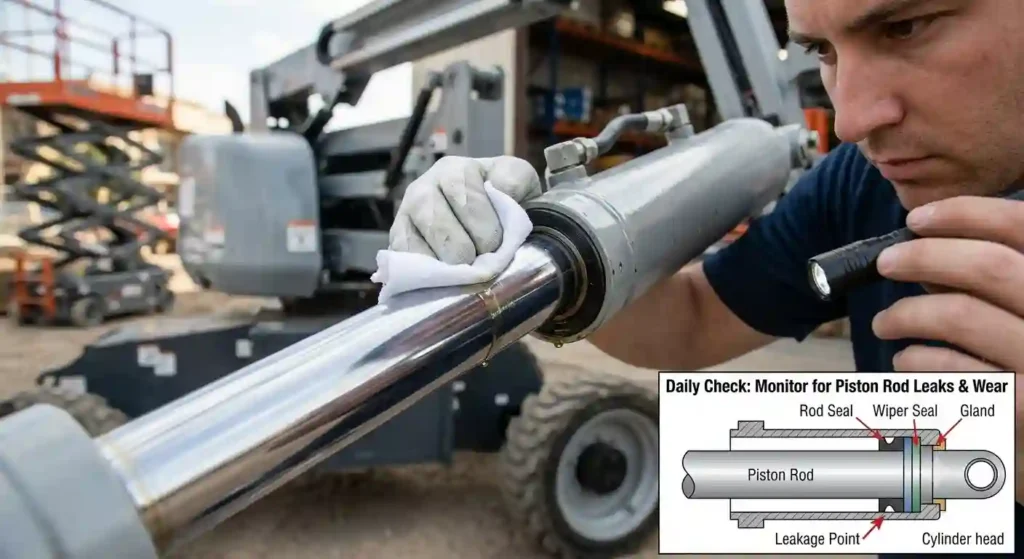
The most effective maintenance activity costs nothing and takes under five minutes: a daily walk-around visual check of the steering cylinder before the first shift. Operators should be trained to look for three specific indicators:
Oil film or wet sheen on the piston rod: A light oil film is normal as it lubricates the rod seal. However, droplets accumulating at the rod seal gland, fluid running down the cylinder barrel, or a pool of oil on the frame below the cylinder all indicate seal degradation requiring immediate attention. Left unaddressed, what begins as a minor weep becomes a full seal failure within weeks of continued operation.
Rod surface condition: Inspect the chrome-plated piston rod for scoring, pitting, rust spots, or deep scratches. Any surface defect that can catch a fingernail will accelerate seal wear with every stroke cycle. Rods with minor surface rust can sometimes be cleaned with a non-abrasive metal polish; deeply pitted or scored rods need replacement before they destroy the seal pack.
Mounting hardware condition: Check clevis pins, retaining clips, and tie rod end connections for signs of wear, cracks, or looseness. A loose clevis pin introduces lateral loading on the cylinder rod, which is a significant source of premature seal and rod wear on AWVs that operate on uneven surfaces.
Step 2 — Hydraulic Fluid Management: The Lifeblood of Your Steering System
Contaminated or degraded hydraulic fluid is the leading cause of premature hydraulic cylinder failure across all equipment categories. Inside the steering cylinder, fluid contamination works as an abrasive, wearing down the precision surfaces of the piston, cylinder bore, and seal lips simultaneously.
Check fluid level and condition monthly — or more frequently on machines working in dusty, high-temperature, or humid environments. Hydraulic fluid should be clear to amber in color. Milky or cloudy fluid indicates water contamination (often from condensation in the reservoir or a failed reservoir breather cap). Dark brown or black fluid signals oxidation and thermal breakdown. Either condition requires an immediate full system fluid flush and filter replacement.
The reservoir breather filter is frequently overlooked. This small component prevents airborne contamination from entering the fluid as the reservoir breathes during cylinder cycling. On many AWVs, the breather cap is rated at 10 microns; replace it at least annually, or whenever the fluid shows visible particulate contamination.
When topping up or replacing fluid, always use the hydraulic oil grade specified in the AWV manufacturer’s service manual. Mixing incompatible oil grades or viscosity classes can compromise seal swell behavior and cause unexpected system pressure variations affecting steering response.
Step 3 — Seal Inspection and Scheduled Replacement: Don’t Wait for a Leak
Hydraulic seals are consumable components with a defined service life. On aerial work vehicles used in commercial operations — typically 6–8 hours of daily use across five or more days per week — steering cylinder seals should be proactively inspected every 1,000 operating hours and replaced every 2,000–3,000 hours, regardless of whether active leakage is present.
A complete seal kit for a standard AWV أسطوانة توجيه مركبة العمل الجوي typically includes the piston seal, rod seal, wiper (dust) seal, and any O-rings associated with port plugs or end cap joints. When replacing seals, it is sound practice to replace the entire kit rather than individual components — mixing seal generations with different wear states leads to uneven loading and premature failure of the new seals.
During seal inspection, examine the removed seals carefully. A piston seal showing even wear across its contact surface indicates healthy operation. Asymmetric wear (heavy on one side) suggests misalignment between the cylinder rod and the steering linkage — a mechanical issue that must be corrected before installing new seals, or the new set will fail rapidly.
Step 4 — Cylinder Alignment Check: The Silent Killer of Hydraulic Seals
Hydraulic cylinders are designed to transmit forces along their central axis. When a cylinder operates out of alignment — whether due to bent mounting brackets, worn clevis pins, or a frame that has shifted after a collision — the piston rod experiences side loading. This off-axis force presses the rod against the gland seal at an angle, creating concentrated stress points that cause seals to fail in a fraction of their normal service life.
On scissor-lift AWVs, where the chassis flexes during operation on uneven surfaces, alignment should be checked every 500 hours using a straight edge across the cylinder mounting points and tie rod connections. Acceptable lateral deviation for a steering cylinder rod is typically under 0.5 mm over the full stroke length; consult the OEM service manual for exact tolerances.
When an AWV has been involved in any collision — even a low-speed dock strike or kerb impact — the steering cylinder alignment should be verified before returning the machine to service. Frame distortion from impact is not always visible to the naked eye, but its effect on cylinder alignment can be significant.
Step 5 — End-of-Season Storage Preparation: Protecting the Cylinder During Downtime
For AWV fleets stored seasonally or placed in long-term reserve, the condition of the steering cylinder during storage is as important as during operation. The primary risks during storage are seal desiccation and corrosion.
Before storage: fully cycle the steering cylinder through its complete extension and retraction range several times to flush any contaminated fluid from the working chambers and coat the bore surfaces with fresh oil. Then, retract the piston rod fully so that the chrome rod surface is inside the barrel, protecting it from atmospheric corrosion. If full retraction is not possible due to the machine’s design, apply a thin coat of corrosion-inhibiting oil to any exposed rod surface, and fit a protective rod boot or wrap where available.
Check and top up the hydraulic reservoir before storage to minimize the air space above the fluid — a larger air space means more moisture condensation potential. Store the machine in a covered, dry environment where temperature fluctuations are minimized to prevent seal hardening from thermal cycling.
Equipment managers who also handle agricultural machinery — for example, those overseeing both AWVs and tractor-attached equipment like round balers on farm estates or agribusiness facilities — will find that similar hydraulic preventative maintenance principles apply across platforms. You can review maintenance-aligned equipment options at hay-balers.com for related cross-equipment service planning reference.
Building a Maintenance Schedule: Recommended Intervals at a Glance
| Frequency | Maintenance Task |
|---|---|
| Daily (pre-shift) | Visual rod and seal inspection; check for leaks and rod surface damage; verify mounting hardware tightness |
| Monthly | Hydraulic fluid level and condition check; reservoir breather filter inspection; clevis pin lubrication |
| Every 500 hours | Cylinder alignment verification; full hydraulic fluid sampling and analysis; mounting bracket torque check |
| Every 1,000 hours | Complete seal inspection; system pressure test; fluid flush and filter replacement |
| Every 2,000–3,000 hours | Full seal kit replacement; rod surface assessment; end cap inspection |
| Seasonal / Storage | Full retraction rod protection; reservoir top-up; corrosion inhibitor application; boot/cover installation |
When Maintenance Is Not Enough: Replacement Indicators
Even with diligent maintenance, steering cylinders eventually reach end of service life. Replace the cylinder — rather than attempting further seal repair — when any of the following conditions are present: deep scoring of the cylinder bore visible on inspection, barrel wall thinning from corrosion pitting, bent or bowed piston rod (detected as irregular motion through the stroke), cracked or corroded end cap welds, or thread damage at the clevis ends that prevents secure mounting.
Attempting to operate a structurally compromised steering cylinder on an elevated work platform is a serious safety risk. The cylinder must withstand dynamic hydraulic loads while simultaneously resisting the lateral forces from steering inputs at full wheel turn — any structural weakness can lead to sudden failure at the worst possible moment.
Need Replacement Steering Cylinders or Seal Kits?
Canada oxygen-compressor-cylinder-filling Co., Ltd carries replacement aerial work vehicle steering cylinders and complete OEM-equivalent seal kits for major AWV platforms. Our technical team can match specifications to your machine model and advise on seal material selection for your operating environment.
📧 Send your machine model and current cylinder dimensions to [email protected] — we’ll confirm compatibility and pricing within one business day.